
5 Reasons Women Are Replacing Their Shampoo With This 4,500-Year-Old Fruit

Zero synthetic surfactants. Every ingredient edible. Used on hair for 4,500 years. And it exposes what the "natural" bar in your shower has been hiding from you.

Already know shikakai? Check availability →
First, the Lie on Your "Natural" Shampoo Bar
If you're reading this, you already figured it out. Natural beats synthetic. In your food. On your skin. In your home.
You read every label. You look up every word you can't pronounce. You've gone all over the place trying to find something truly natural. Sulfate-free bottles. "Natural" bars. Organic brands at three times the price. Maybe you even tried going no-poo.
Think about what you've spent on bars that let you down.
You did everything right.
But you still got lied to.
That's not your fault. Most "natural" shampoo bars are not natural. Not even close. Here are three ways to check yours.
Sign 1: It has an ingredient no plant on Earth makes.
Flip your bar over. There's usually one ingredient that doesn't belong. Look for Sodium Cocoyl Isethionate. SCI.
It's in most "natural" shampoo bars.
Now ask yourself one question. When did you last see SCI growing on a tree?
As an Ayurvedic specialist, I have one rule. If you can't find it in nature, it isn't natural. Full stop.
The FDA has no rule at all. It has never defined what "natural" means on a shampoo. Not once. So any brand can print the word on anything. And thousands do, every single day.
Sign 2: It's a colour nothing in nature comes in.
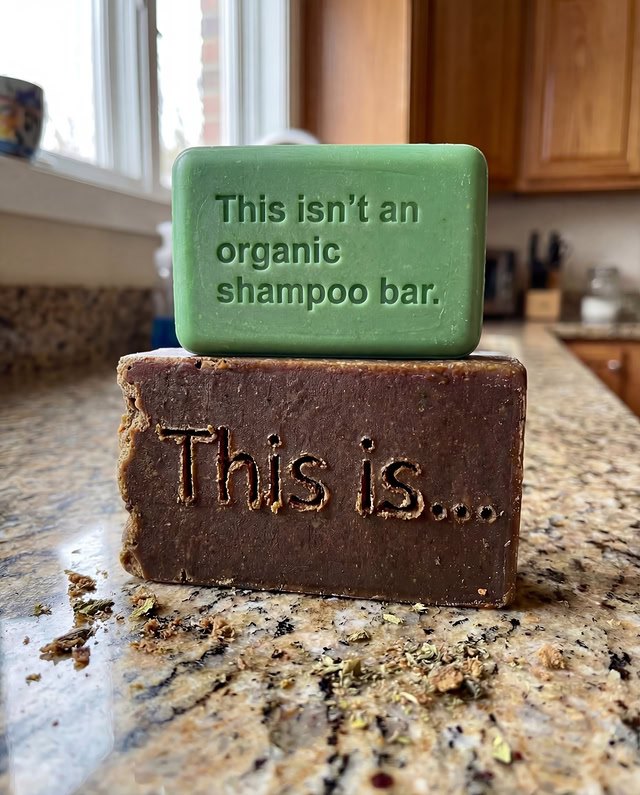
Neon green. Bright pink. That perfect, even, glowing blue.
Plants don't come in neon. When real herbs are cooked into real soap, the bar turns brown or green-brown, with little specks in it. Never glowing.
If your bar glows, something in it was made to.
Sign 3: Your hair is still paying for it.
You switched to natural. But you might still be noticing it. Your hair still feels stripped. Still dry. Still thin. Greasy at the roots by the next morning, dry at the ends. Your scalp still itching.
And why does the bar smell like a perfume counter? No garden on Earth smells like that. The word "fragrance" on a label can hide dozens of chemicals, and the FDA lets brands keep every one of them secret.
What's Really in These Bars?
Take SCI. It's made using ethylene oxide. The US government lists it as a known human carcinogen. So does the World Health Organization's cancer agency.
That's what "natural" means on a label today.
But that's not even the worst part. The worst part is what SCI does to your scalp, every single wash.
SCI is gentler than a sulfate. It still strips.
Like most synthetic surfactants, it carries a negative charge. Your hair and scalp carry spots with a positive charge. Opposites attract. So SCI grabs onto your scalp and rips away everything. The dirt. The extra oil. And the thin layer of natural oil your scalp needs to protect itself.
It's like washing your face with dish soap. Squeaky clean for a minute. Then tight and dry, and oily again by lunch.
Your scalp panics. Its protection is gone, so it pumps out more oil to replace it.
Your roots get greasy faster. So you wash again. It strips again. It panics again.
Round and round. For years.
And your ends, which that new oil never reaches, dry out, snap and break.
This is the strip-and-overcompensate cycle. If you've been using "natural" bars, you've probably been stuck in it the whole time. And that green leaf on the box never once stopped it.
Every year in that cycle is another year of stripped roots and broken ends.
The Question That Changed Everything for Me
I know that cycle because I lived it. My roots were greasy by the next morning, and my ends felt like straw. I switched to sulfate-free, then to the "natural" bars. But nothing changed. So I started to think it was just my hair.
But then I started reading the labels properly. And once I saw it, I couldn't unsee it.
So I asked myself one question. What did people wash their hair with before any of this existed? Before sulfates, before SCI, before shampoo was ever invented?
The answer was a fruit.
It's called shikakai (say "shee-kah-kai"). In Tamil, the language of south India, the name means "fruit for hair."
Crush a dried shikakai pod and rub it between wet hands, and it foams. The fruit makes its own soap.
People in India have washed their hair with it for 4,500 years. Traces of it were found at an ancient site in India dating back to around 2500 BC, around the time the pyramids were being built. And in Tamil Nadu, in the south, women never stopped using it. The same way their great-grandmothers did. And their great-grandmothers before them.
Here are 5 reasons I recommend shikakai-based products to every woman who asks me.
It Cleans Your Hair Without Ripping Away the Oil Your Scalp Needs
Remember how SCI grabs your scalp and takes everything with it?
But shikakai doesn't.
Inside every pod are saponins. They're what makes the fruit foam. Each saponin has two ends. One end grabs oil and dirt. The other holds onto water. So when you rinse, the water carries the dirt away.
But saponins carry no charge. They have nothing to grab your scalp with. And they're big and bulky, built around chains of natural sugar, so they can't dig in the way small synthetic molecules do.
So shikakai lifts only what's sitting loose on top: dirt, sweat, build-up and extra oil.
The oil your scalp keeps there on purpose stays exactly where it belongs.
| SCI and other synthetic surfactants | Shikakai saponins | |
|---|---|---|
| Made by | A chemical plant | A fruit |
| Charge | Negative, grabs your scalp and hair | None, nothing to grab with |
| Size | Small, digs in | Big and bulky, stays on top |
| Removes | Dirt, extra oil and your protective oil | Dirt and extra oil. Nothing more. |
No strip. No panic. No cycle.
And because nothing gets stripped, there's nothing to put back. That's why you don't need a conditioner.
Feed, don't strip. That's how hair was washed for thousands of years.
Hair that's clean, not stripped. Roots that stay fresh for days, not hours. And no conditioner, because there's nothing to repair.
It Feeds Your Scalp While It Cleans
A synthetic surfactant does one job and goes down the drain.
Shikakai is a whole fruit. So along with its soap, it brings everything else the fruit is made of.

A calmer scalp. Shikakai contains lupeol, which helps soothe itching and irritation.
Oil that settles down. Its spinasterol helps balance your scalp's oil.
Softer hair, without silicone. Acacic acid helps smooth the outer layer of each hair.
Protection from daily damage. Its flavonoids are natural antioxidants.
A cleaner scalp. Its tannins are natural astringents.
Nutrients in every wash. Vitamins A, C, D, E and K, which your scalp and hair use every single day.
Lab studies have also found that shikakai extract can improve follicle density and help keep hair in its growth phase longer.
Your shampoo takes from your scalp. Shikakai gives back. It feeds your scalp from the root up. Feed, don't strip.
No scalp serum. No silicone to fake the shine for a day. The wash itself is the treatment.
But shikakai was never meant to be used alone.
The Original Hair Wash Wasn't Just Shikakai. It Had 10 More Plants.
The very first hair wash was simple. Crushed shikakai and water, mixed into a paste.
Over time, more plants were added, each one for a reason. In Ayurveda, shikakai became the base, and the herbs around it did the rest.
These are the 10 ingredients that go in alongside it. Every one is edible and organic.
Herbs
- Amla (Indian gooseberry): one of the richest natural sources of vitamin C, which your body uses to make collagen around every hair root. In Ayurveda, it's the classic herb for thick, dark hair.
- Neem: studied for fighting fungus and bacteria. In India, it's the go-to herb for dandruff and scalp problems.
- Hibiscus: full of natural slip that helps your comb glide through, and amino acids, the building blocks of the protein your hair is made of.
- Nettle: rich in silica, a mineral found in strong hair, plus vitamins A and K.
Oils
- Coconut oil: gives the bar its soft, creamy lather.
- Argan oil: vitamin E and fatty acids that soften hair and tame frizz.
- Castor oil: locks moisture in and makes the lather last.
- Rosemary: in a 2015 study, rosemary oil did as well as minoxidil 2% over six months, with less scalp itching.
- Bergamot: a citrus peel oil with natural antibacterial properties.
- Lavender: calming for your scalp and your mind.
You won't find most of these in a commercial shampoo. They cost too much, and they can't be grown by the ton. Shikakai grows wild across India, especially in the hills around Madurai.
No synthetic surfactants. No sulfates. No silicones. No parabens. No synthetic fragrance. Nothing hiding behind the word "fragrance."
Eleven ingredients you can read, say out loud and look up yourself.
The Original Ayurvedic Hair Wash Recipe Is Not Completely Lost
At first, shikakai was used as a paste, on its own. Later came the original shampoo recipe: shikakai cooked with oils and herbs.
Unfortunately, 99% of those Ayurvedic workshops are gone, replaced or pushed out by commercial factories. Only a handful are left. And the ones still standing are in Tamil Nadu, around the city of Madurai, where the recipe comes from.
On my trip to India, I found one of the very last factories that still makes it 100% the original way. Here's exactly how.
The herbs grow wild.
Shikakai and many of the other herbs grow wild in the hills around Madurai. They can't be farmed. Plants like these don't survive rows, sprays and pesticides. So they were organic long before anyone put the word on a label. Local tribes in the Madurai hills pick them and sell them in the city, and the factory buys straight from them.
Fresh herbs go in on the day.
The dried herbs are joined by fresh ones, bought on production day. Fresh herbs still hold what dried herbs lose sitting in storage. That's a big part of why you can feel the difference in your hair.
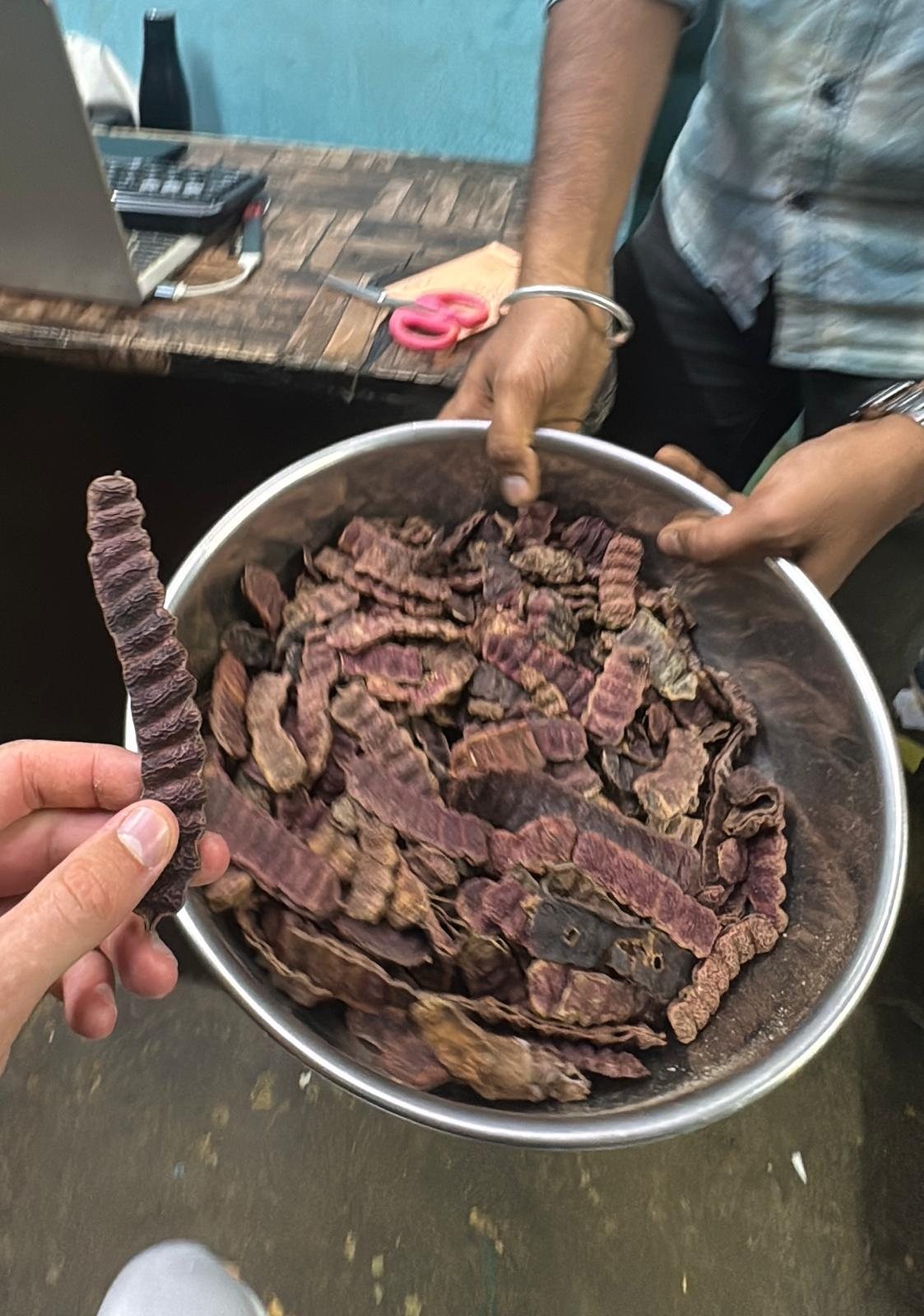
Everything is cooked for two days.
The herbs and oils go into one giant pot and cook slowly, the old way, until the oil has pulled everything the plants have to give.

Then it becomes soap.
Food-grade lye is added. It's what turns oil into soap, the same job soap makers once did with wood ash. It's used up completely along the way, so none is left in the finished bar.
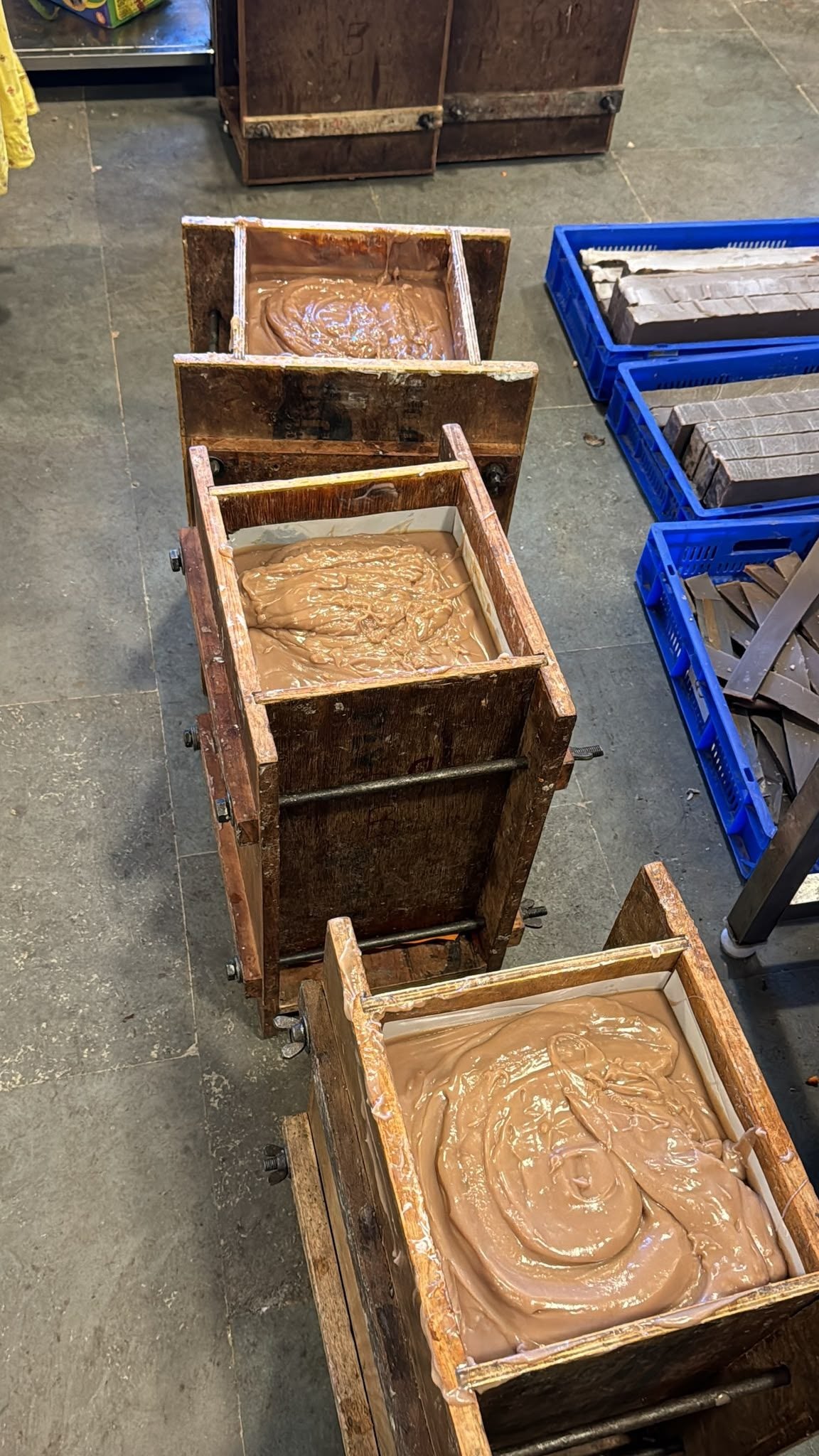
It sets in wooden moulds.
The hot soap is poured into wooden moulds, where it rises and hardens.
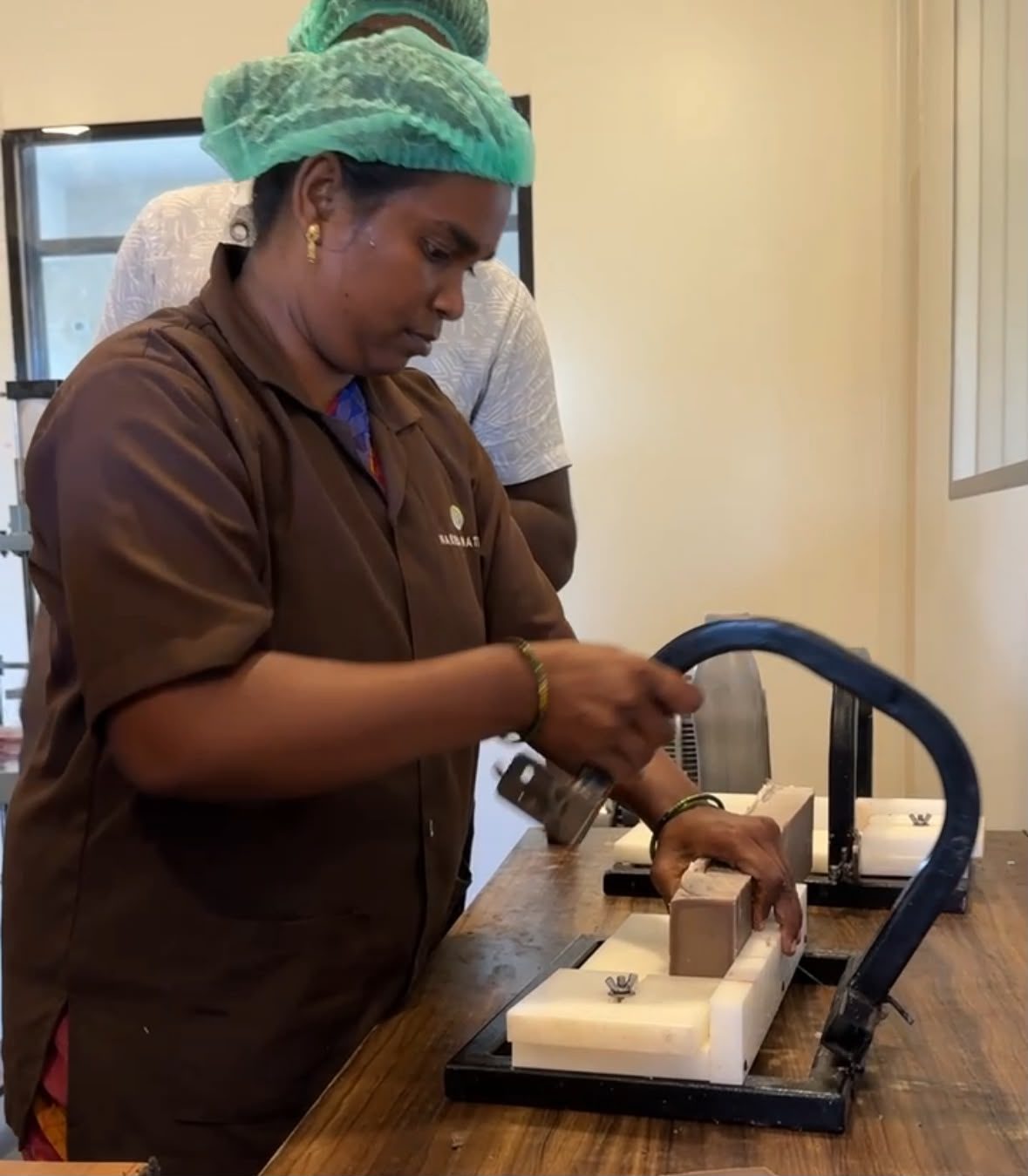
Every bar is cut by hand.
That's why no two bars look the same. The edges are rough, and you'll see little specks of the herbs cooked right in.
Then it rests.
The bars cure for two weeks so they harden and last longer in your shower.
Then it's wrapped in organic cotton.
No plastic. Not once, from India to your door.
One batch is 500 bars. It takes 12 people a full week, all by hand, and then two more weeks of curing. That's why this isn't a $6 bar.
And they've refused to change.
Staying this way hasn't been easy. Local politicians have come to the factory more than once, offering money to take it over and turn it into a commercial factory. Every time, the owners said no.
They've also refused to grow. Making more would mean cutting corners, and they won't risk the quality. So they make about 500 bars a month. That's why these bars have sold out four times in the last two months.
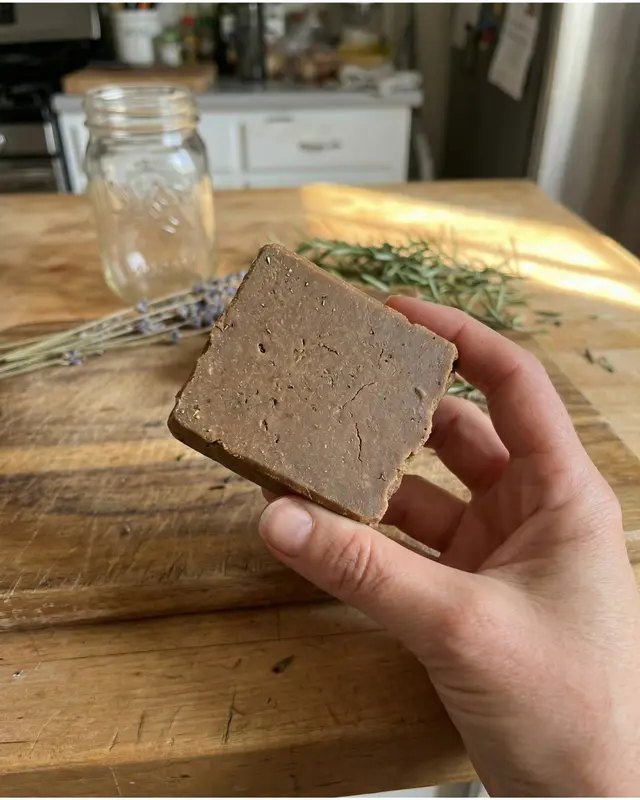
This is what one bar looks like.
The first time I washed with it, I noticed the lather first. Soft and creamy, not big and bubbly. It smelled like herbs, not perfume. My hair felt clean, but not tight. And the next morning, my roots were still fresh.
Check availability →8,300+ Women Have Already Stopped Trusting the Label and Started Trusting the Plant
Even in India, most people have fallen for the lie and switched to commercial shampoos, because they're cheaper to make. But the women who kept using shikakai, or went back to the original recipe, have been seeing the results all along, while almost nobody else even knew the recipe existed.
The bars from that factory are called Hikakai, named after shikakai.
Shikakai and 10 edible plants, in one handmade bar.

60-day money-back guarantee · Free shipping over $35
So women who had given up on "natural" shampoo bars are finally washing with something they can trust, all the way down to the last ingredient. Because they finally know the truth about shampoo.
Shikakai cleans without stripping.
10 herbs and oils feed your scalp.
The original method means nothing is hidden.
And if it doesn't work for you, you get every cent back.
This isn't a trend. It's discovering the truth of what shampoo always was. You're joining women who read every label, just like you, and finally stopped searching.
What to Expect, Day by Day
Day 1: You order.
Your bar ships from our USA warehouse and arrives in 2 to 3 days, in an organic cotton bag. No plastic.
The day it arrives: You open it.
You smell herbs, not perfume. Rosemary. Lavender. A little citrus. You see the green-brown specks and feel the rough, handmade edges. Every bar is a little different.
You also get our Ayurvedic Hair Secrets Guide, so you can find your dosha and set up your own hair ritual.
Your first wash.
The lather is different. Soft and creamy, not big and bubbly.
When you rinse, your hair feels clean, not squeaky. It dries soft, with its own natural oil still there.
Week 1.
Your scalp feels calmer. The itch starts to fade. Your conditioner goes back in the cupboard, for good.
Week 2.
You're washing less. Your scalp isn't racing to replace stripped oil anymore.
Week 4.
You may start seeing thicker, fuller hair, fewer dry ends and less hair falling out.
And for the first time in years, people start asking what you've been using on your hair.
What Women Are Saying
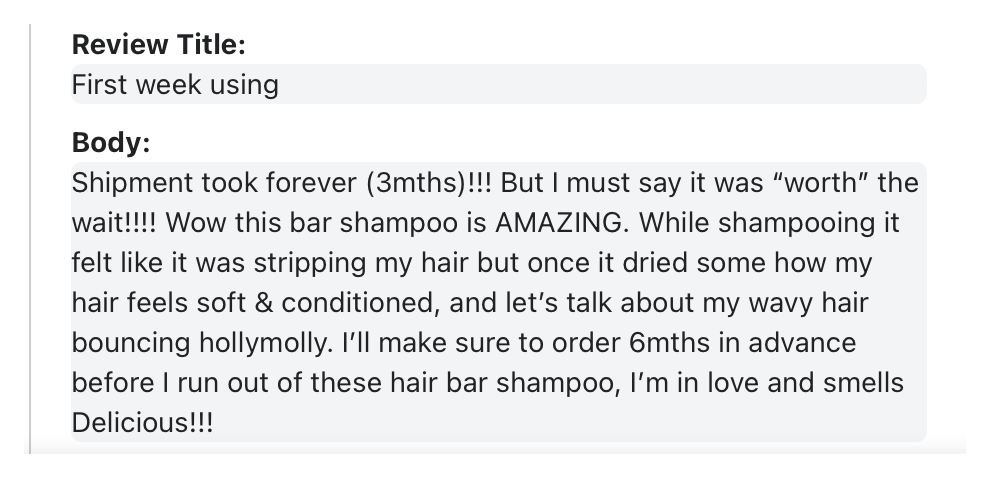
"Wow, this bar shampoo is AMAZING."
While shampooing it felt like it was stripping my hair, but once it dried somehow my hair feels soft & conditioned, and let's talk about my wavy hair bouncing, holy molly. I'll make sure to order 6 months in advance before I run out of these hair bar shampoos. I'm in love, and it smells delicious!
Jocelyn · wavy hair · first weekIt lathers well even with my hard water. I don't typically use a conditioner, and at first after rinsing my hair felt a little stiff, but after just drying with a towel it felt soft. Definitely a great product.
Lynn · hard water · no conditionerI'm surprised by how well it lathers, and I only need a little. Used it 3 times so far, so good. Haven't tried eating it yet, with all natural ingredients 😂
Carol · after 3 washesIn stock · Ships from the USA in 2 to 3 days
Check availability →60-day money-back guarantee. Full refund, no questions asked.
Now You Know What Should Be in Your Shampoo
A natural shampoo bar and a conditioner bar together cost about $30. Hikakai starts at $22.99. And because it doesn't strip your hair, you don't need the conditioner, or the hair masks to repair the damage.
- 100% edible ingredients
- 100% organic
- 100% handmade
- 100% the original Ayurvedic shampoo recipe
- 100% made in the original location, Tamil Nadu
- 100% organic cotton bag
- 60-day money-back guarantee
- Lasts 1 to 3 months
Each batch is only 500 bars, and they've sold out four times in the last two months. When a batch is gone, the next one is weeks away.
Every wash with a synthetic surfactant is another strip. The years already spent in that cycle don't come back.
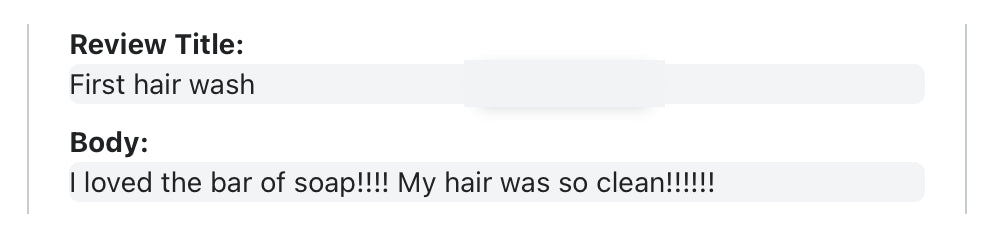
Straight From Our Inbox

Frequently Asked Questions
Do I need a conditioner?
Most people don't. Most conditioners exist to fix damage from harsh shampoos. They coat your hair in silicone so it feels smooth. Shikakai doesn't strip your hair, so there's nothing to fix. If you have very long or dry ends, use a little conditioner on the ends only.
How is this different from other natural shampoo bars?
Most natural shampoo bars still clean with a synthetic surfactant, like SCI (Sodium Cocoyl Isethionate). Hikakai has zero synthetic surfactants. It cleans with shikakai and real soap made from plant oils, cooked by hand the old way.
Will it work with hard water?
Yes. The hot process makes true soap, which rinses clean in any water.
Does it actually lather?
Yes. Coconut and castor oil give it a soft, creamy lather. It won't foam like a sulfate shampoo, because it doesn't strip like one. Rub the bar straight on your wet scalp, then work the lather through your hair.
How long does one bar last?
1 to 3 months, depending on your hair length and how often you wash. Keep your bar out of the shower stream so it dries between washes.
Do I have to subscribe?
No. On the product page you can choose to buy once instead. If you subscribe, you can cancel anytime from your account, or email info@hikakai.com and it's handled within 24 hours.
What if it doesn't work for me?
You get a full refund within 60 days, no questions asked. Just email info@hikakai.com.
When will I get my order?
Orders ship from a warehouse in the USA and arrive in 2 to 3 days. International orders take 7 to 21 business days. Shipping is free on orders over $35.
What does it smell like?
Like an herbal garden. Rosemary, lavender and a light citrus note from bergamot, over a warm, earthy base. No synthetic fragrance, so what you smell is the actual plants.
Why is there lye in it?
There is no soap without lye. Lye is what turns oil into soap, and it gets used up completely while that happens. There is no lye left in the finished bar.
Why does every bar look a little different?
Because every bar is cut by hand. The shape is rough, the colour can shift from batch to batch, and you'll see small specks of the herbs inside.
Why is it sometimes sold out?
The factory makes about 500 bars a month, by hand, and won't speed up. When a batch sells out, the next one is weeks away.
Who is behind Hikakai?
Hikakai is sold by SBTB Global LLC in the USA. Orders ship from a USA warehouse, and every email to info@hikakai.com is answered by a real person, not a bot.
You've tried everything they sold you. Now try what came before all of it.
Check availability →60-day money-back guarantee · Cancel anytime